

Mrs. Woodrow
by Elizabeth Perez
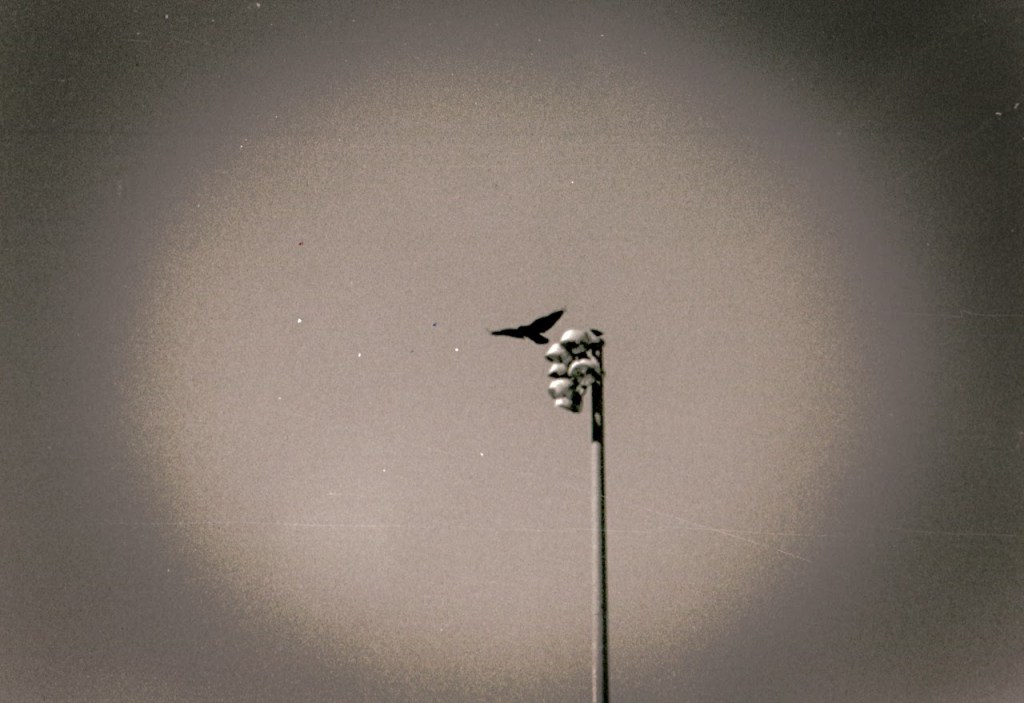
Bird on a Light Pole, a picture by Jordan Rich (grade 11)
Jane Fitzgerald was what common folk would call an “average” woman. Perhaps, for once, the common folk wouldn’t be necessarily incorrect. She was fair-skinned, thin, and pretty. All of her dresses were neatly cinched under the bust, and they were colored with what seemed to be a lifeless, dusty-colored ink that failed at its one job of bringing vibrance to clothing. Her father was a farmer, and, despite their low social status, Jane’s family was quite well-off.
Although she was certainly an agreeable woman, there was nothing particularly unique about her. The two most interesting things about Jane were her talent in music (specifically cello), and her hobby of carving pieces of firewood into lambs. The latter would make for a lovely conversation starter, but it’s safe to assume that Jane did not see it as a respectable pastime, and she could not handle the idea of being anything other than respectable in her household. Her entire family had faces and souls reminiscent of ethereal beauty; even her mother, battered by the troubles that come with age, remained as eternally beautiful as she once was.
The majority of everyone would agree the most attractive Fitzgerald daughter was Anne, the middle child, whose quiet confidence was striking and memorable. Next to Anne, Jane was but scraps. The youngest Fitzgerald daughter, Catherine, was five years younger than Jane. She was relatively tomboyish compared to her sisters, and definitely on the more reckless side, yet still caring. They were an inseparable trio, the three sisters, and it was hard to pull them apart, even for a second.
For that very reason, one morning, when Jane woke up to the absence of the middle child, she was understandably concerned. She removed the white satin gloves she had pulled on while she was dressing. In an attempt to distract her wandering mind, she turned to her newest lamb carving project, but was unsuccessful. She could not focus on carving her precious little wooden creature without having a general idea of her sister’s whereabouts and walked down the fragile, winding stairs of her household in hopes to find her mother.
The house was quiet without Anne, and every step of every shoe could be heard in every corner of every room. Sure enough, her mother was dusting the furniture in the hall, thumbing at the crannies between the golden details of their wooden drawers. Her mother had a slight obsession with perfection, and, although they could likely afford a housemaid, she took it upon herself to fight every individual dust bunny in her own way.
“Mother,” Jane called. “Have you seen Annie?”
“Good-morning,” she replied nonchalantly, not meeting eyes with her daughter.
“Good-morning,” Jane corrected. “Have you seen Annie?”
“You mean your sister, Anne?” the woman asked, raising her dark brown eyebrows and faking confusion. Mrs. Fitzgerald did not like nicknames, especially not the ones designated to her daughters.
Shaking her head, Jane repeated herself. “Yes, Anne, have you seen her?”
“No, not me,” Mrs. Fitzgerald answered. “The horses, perhaps, but I do believe she left early morn. If anyone has seen her, it ought to have been your father. It wouldn’t hurt to ask the horses, someone a little less occupied.”
“She did not warn you?” Jane asked, ignoring the latter.
“No, she did not,” Mrs. Fitzgerald replied.
“She would have told you, if she told anyone.”
“I am telling you,” Mrs. Fitzgerald said, finally looking up at her eldest daughter, “I have not the slightest idea of where Anne could be. Forget your worries. She is a child no longer and certainly has business to attend to. Besides, it would do us good to get a daughter out of the estate.”
“It isn’t like Anne to disappear,” Jane commented. “I will go ask Papa. If he doesn’t know, I shall go look for her.” Throwing her wrinkly arms up in the air, Mrs. Fitzgerald exclaimed, “O, Lord! Two daughters out of the estate! How you have blessed me, o Lord! Bring my Catherine with you, perhaps I can get the whole of three out of here.”
“Luck to you,” Jane said sarcastically, giggling a little at her own remark.
“Luck to you,” her mother said firmly. “Seventeen and, yet, you are still on the estate of your father! You should be engaged, at the least, by now!”
“You married quite late for your time, Mother,” Jane said.
“Yes, darling, but things have changed. The men are all gone and the women are all handsome. You cannot forget to secure a husband before your complexion loses its fairness,” Mrs. Fitzgerald continued, her breath trailing on, “And I cannot have an unmarried daughter because I have no son to care for her.”
“Mother,” Jane said, grabbing Mrs. Fitzgerald’s hands with hers, “Has anyone ever told you what an excellent conversationalist you are? You really are an excellent conversationalist. I could speak to you for hours, really, but I must be off to look for Annie. Thank you for your wisdom.”
Unsurprised by her daughter’s sarcasm, Mrs. Fitzgerald brushed Jane off, and Jane went out the door to find her father. The grass that morning was soft; unbothered by nature’s sorrow. The girl’s ankles did not moisten because of typical English raindrops gracing the grass. Instead, it was a dry feeling; even the soil had been warmed by the sun. Jane did not notice the warmth of the earth, but, rather, thanked a god for choosing to leave the ends of her dress dry. Today was not a day she felt like putting up with the cold feeling by her feet.
After walking for some time towards her father’s workshop, she saw him there, sawing at some wood he had likely picked up the day before.
“Papa,” she said, waving at him.
“Miss Jane,” he replied, smiling.
Jane leaned against his wooden workbench. “Have you seen Annie?”
“No, not at all.”
“She is not at home.”
“Have you asked your mother?” Mr. Fitzgerald suggested.
“She doesn’t know of her whereabouts either.”
“Perhaps you can take the carriage to town.”
“I do not wish to bother you, Papa,” Jane said with a soft smile on her face. “I will walk to town and find her.”
“You oughtn’t go alone.”
“It’s a quick trip,” she reassured, rubbing his arm with her bare hand. “Besides, she couldn’t have traveled too far without the carriage.”
“If you must go, do go with haste,” Mr. Fitzgerald said. “I cannot bear the feeling that I am losing my daughter.”
“You could not lose me, Papa.
With that, they parted, and Jane went home to her bedroom to take a couple of things to town. She figured she should go to the market if she was to make the trip. She did not plan to buy anything, but, instead, wished to deliver one of her lovely little wooden lambs to the man with whom she had been infatuated with, Mr. Woodrow. Her heart paid no mind to the labors of his low status job, or to his relative poverty. He had always been well-mannered and agreeable, and especially polite to Jane’s tricky family. The thought of him eased her mind, and now her young sister was not a trouble her cerebrum was nervously concerned with.
Jane then heard a knock and a voice coming from the door.
“Jane, it’s Anne, she’s back!” her youngest sister Catherine exclaimed.
“Tell her that I will speak to her in a moment,” Jane said, quickly stowing her wooden lamb.
“Anne is here,” Anne’s sweet voice said at the door.
“Oh, Annie!” Jane opened the door and gave her sister a hug.
“Pardon my unexcused disappearance,” Anne said, a soft smile on her face, “But I bring the news of a lifetime. Catherine, come.”
The three girls sat on the bed, Anne holding Jane’s right hand and Catherine’s left.
“Yesterday, I received a letter from an admirer of some sort. It was beautiful and heartfelt and, well…lovely. I was hopelessly enamored, and when Papa said this admirer had already asked him to give up his daughter, I was more than flattered.”
“Oh, who is it?” Catherine asked, excitement gracing her young voice.
“You will be delighted to know,” Anne began, “That I am to wed Mr. Woodrow in the coming months.”
“Goodness!” Jane exclaimed, shielding her disappointment. It took her all in her power to keep a scream at the bottom of her esophagus. “My, Anne! Why hadn’t you mentioned this to us?”
“Papa told me that we ought to keep it quiet because he’s a baker and all.”
Catherine was smiling and squeezing her sister’s hand. “Mother will be so pleasantly
surprised.”
“Oh, my,” Anne whispered, “I must tell her immediately, the thought slipped my mind. Catherine, will you accompany me?”
With that, the two sisters left the bedroom, hand in hand.
Jane was sitting there alone on her bed. All of a sudden, an uncontrollable sob escaped her throat. It had been there ever since the surname “Woodrow” was whispered from the pale pink lips of her sister.
This feeling was new, different and odd. She had experienced sorrow in her lifetime like all other beings, but none quite as striking as was this. It was an uncommon occurrence, Jane thought, quite thankfully. She never wished to feel this way again, even though she had not known the feeling well enough to judge it. The world seemed to crumble. Every hope she had seemed to bleed out with painful discomfort at the thought of them. She did not wish to know what the world was. It had ended. It had long been over. The love of her life sought to marry her dearest sister. Even the mention of it to herself made her choke up. However much the thought made her sick did not matter because it consumed her. Even as she slept, even as she dreamt,
there was no escape. Close followed these pools of emotion she possessed; one Pity, for her, one Guilt because she knew she should not be dwelling on an engaged man, and one Wishful pool. More of a pond or a droplet of a Wish that, maybe somehow, she was wrong and he would appear at her doorstep and beg Jane to be his wife, insisting that she was the one he had loved all along. The pond left a fallacy behind as it evaporated; one of reflective regret. There was nothing, and that made one hope for something. Another drop, another sip, another wade. For Jane, it was that other chance. But there was no man, no doorstep, and no love. The pond was more shallow than did good. Hope was nonexistent. Wishes were surface level.
Once her thoughts were in order, she pulled out her finest quill and wrote her despair onto the wooden lambs she had spent so much time on, using the pigment of her tears to scratch the rough plane until there was no more of it. When she ran out of writing surface, her fragile tears ran down like black ink, flooding her face, and kissing every inch of her body with wet, clear flame.
Jane slipped on her left glove. With her right hand, she attempted to restrain her tears, but it was no use. It would be a long time coming until England saw dry grass once more.


Biography
My name is Elizabeth Perez and I’m a freshman! When I’m not in class, at a club, or doing homework, I’m doing what I love most: reading, writing, and spending time with my family. I also love playing memory games with my bunny, Chippy!
What is your main source of inspiration?
Mainly, I am inspired by my mother. Whenever I face a challenge, I remind myself of what she has gone through and where she has gotten.
What message do you hope to convey through your piece?
My short story as a story is mainly a personal achievement. However, I believe that it isn’t perfect, and that, in itself, is a lesson. By submitting this piece, I was accepting that my story wasn’t flawless, but it still deserved to be out there. In other words, something doesn’t have to be objectively “good” to be valuable.
How do you resonate with your piece? Why is it personal to you?
I had actually experienced something similar to this, although not quite as extreme. I was in seventh grade when a guy I had a mild crush on asked my friend out (oh no, the horror!). I thought the concept would make a good short story, but I never got around to writing it until early this school year. Writing it was like a full circle moment for me.
 Expressions