
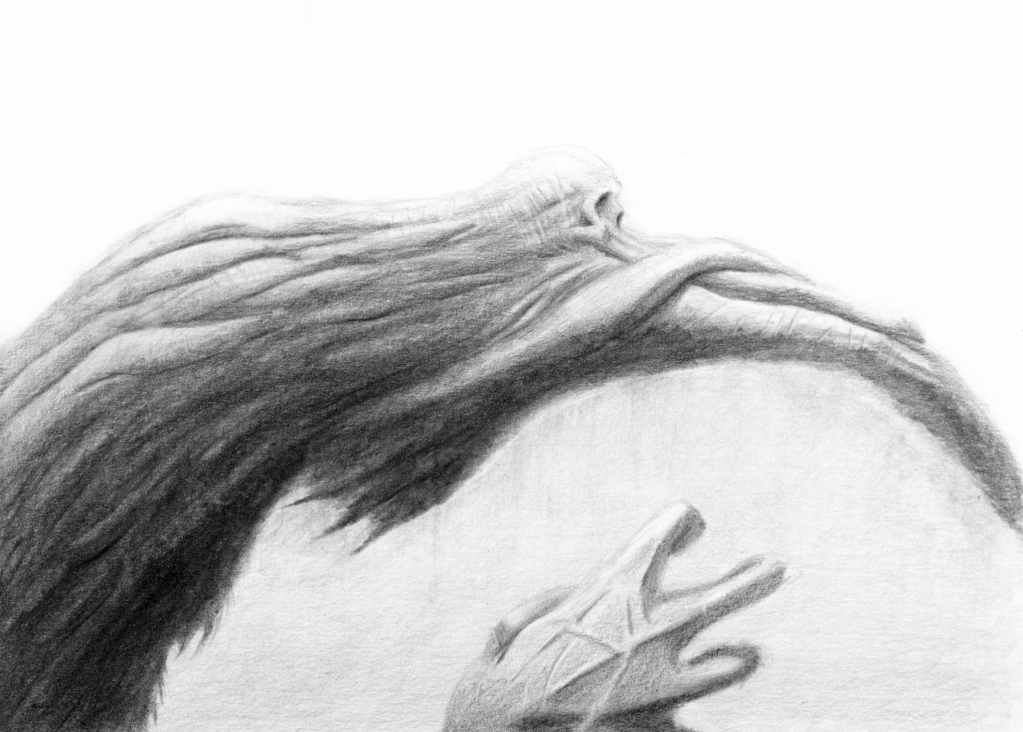
Graphite pencil drawing by 11th grader Vincent Correa
Plumet
By Elizabeth Perez
Quite the oddity she was, Estelle of the smallest Parisian foundling hospital! She was a gem, in her beauty and manner of being. Perhaps, then, that is what made her situation odd as it was—a foundling hospital was no place for a gem like herself.
She was well aware of her social station; however, she was deluded, deceived, and disbelieved—much like her once muddled mother—in the benevolence of men, in the benignity of people, and, so, she believed in love.
Had you observed the girl on her lonesome a few kilometers from the hospital, dressed in a more becoming gown, you would think her a genteel woman of a refined sort of upbringing. Her speaking was ladylike, and she had a tender, feminine air about her, which her countenance did not dare to betray. Her expression was scarcely inscrutable; blankly and invariably, she wore her good feelings on her upturned lips, her brightened eyes, and her rosy cheeks. Her infectious optimism was a privilege seldom enjoyed by orphaned girls like herself, so one would not venture to guess, upon meeting her, that she was a girl of unfortunate station.
Darling Estelle, with her aureate curls and glistening, cloudless eyes, was undoubtedly the favored girl of all the nurses and governesses of the foundling hospital. The wet and dry nurses alike, with their guttural, clipped voices, praised her in unusually hushed words as they rocked the infants to sleep. The governesses, after dining, would gather in the hospital’s little library, discussing the girl’s easy adaptability and sharp mind. To know Estelle, the women believed, was a delight of a unique sort. It pleased them to know of such a pretty girl—beyond that, a girl of such unmistakable kindness!
The other boys and girls always admired her and found little reason to dislike her character; they could find no reason, either, to object to the preferential treatment she received. Estelle always gifted the extra crust of bread she was given to the littlest boy anyway.
Even as she aged, Estelle retained her youthful, softened features and her sweet-tempered, kind self. Should an infant let out a cry, should a maid drop her cloth, Estelle would be the first to appear and offer herself as aid. The women who fed, taught, and raised her all felt a pride in the lady she had become, and Estelle, grateful as she was, felt a pride in having been fed, taught, and raised by them. Eternally indebted to them, she made herself as useful as possible about the hospital, cooking, cleaning, and teaching as she saw fit.
When she reached adulthood, her employment became a pressing matter. She had lived in the foundling hospital for much longer than other orphaned girls, the majority finding a job elsewhere at fourteen or earlier. Estelle, however, at the age of eighteen, had not yet begun working for a wage, her routine tethered, still, to her orphanage.
The matron of the hospital was quick to find her work in a private estate, owned by a wealthy nobleman or other. Beautiful as she said his grounds were, he was much too far from Paris for Estelle’s liking, and she politely declined the offer.
Instead, she took up work as a chambermaid in a nearby inn, ensuring that she was not too far from the structure that housed all of her childhood. Besides the advantage of proximity, it was entertaining work. She met many kinds of people, and, though they were brief, there was always much to learn from the interactions they shared.
It was intriguing, too, for the guests to meet a chambermaid of such beauty and perfected manners. Though the inn was not particularly unembellished—it was rather ornate—it seemed like her presence brightened the chambers, her hair, ringlets of spun gold, reflecting every sliver of day that shone through the windows.
One early morning, as Estelle dusted a chamber’s sideboards with her delicate plumet, she heard the approaching clatter of horse hooves and a low, proclaiming drum. Carefully, she set her plumet on a nightstand, peering out the window and down at the road before the inn.
Revolutionaries crowded at the inn entrance, waiting to be billeted. They were a boisterous group, chanting words in favor of the war and profanities to the detriment of the king. She saw, despite the obscenities, a look of sheer, unfiltered joy on their faces. She wore a small smile as she made her way out of the chambers and downstairs.
The innkeeper, a well-fed, stout man, was speaking to an officer, his brows furrowed. Estelle stepped towards them.
“A warning, beforehand, would have been preferable,” the innkeeper said.
“You must know, my friend, that we are as surprised to be in Paris as you are to see us here,” the officer replied, his French of a cool sort.
“Excusez-moi, monsieur,” Estelle said, “I have all of five chambers cleaned, each easily occupiable by two or four modest soldiers. If all the rest will wait a half hour, I will help Marie clean her vacant chambers, and we will have another five.”
The innkeeper’s face softened upon seeing Estelle, his knitted brows unraveling. “Une perle!” he exclaimed praisingly, placing a gentle hand on her arm. “Very well then, Estelle, see twenty men to their chambers.”
After a moment, the officer called for twenty soldiers to follow her to their chambers.
She curtsied briefly to both the innkeeper and officer before leading the men up the stairs, all of who followed her absentmindedly. When she reached the last chamber for the last four soldiers, she opened the door, a small smile on her face.
“I hope you are pleased with your assignments,” she said, allowing them in. “There is a bell, should you need linens or water. The common room is at the end of the hall.”
One man, of considerable height, took a seat on the edge of the bed nearest to the window, looking towards the chamber door blankly. Another two took the bed closest to the door, pulling a variety of small objects out of their pockets and onto the mattress.
The fourth man, of a warm profile, remained standing by Estelle, his eyes fixed on her.
“Merci, mademoiselle,” he said, a hand reaching up to remove his hat. “How should we call you?”
“You might ask for Estelle,” she answered.
“Very well,” he conceded, smiling a small smile.
For a moment, he simply looked at her, examining her features. His gaze was not a scrutinizing one; it was more of a curious, interested look.
“Thank you for your welcome,” he added. “It is appreciated more than you know. We are quite unaccustomed to placidity, you see.”
“It is but my duty, monsieur,” Estelle said humbly, smiling. “Though I confess I find great pleasure in it.”
He smiled again at her, nodding his head and clutching his hat to his chest. He spoke again, his tone sincere. “Yes, well, you should know we are thus comforted.”
Estelle looked at him for a still moment, her head tilted ever so slightly. “Wonderful,” she concluded, curtsying.
He bowed his head in response, stepping away to allow her to exit.
Carefully, Estelle shut the door behind her, leaning against it for a split second before decidedly making her way towards the staircase. Marie, another chambermaid, stood by its railings, resting against them. Her fiery hair was braided and tied up as usual, her hands adjusting her apron. She glanced up and saw Estelle.
“Estelle!” she called, waving.
“Marie,” Estelle said, approaching her.
“Have you met the soldiers?” Marie asked, leaning over another railing. “Many are but boys, don’t you think?”
“There are many boys, yes,” Estelle answered neutrally, her thoughts elsewhere.
“They are loud,” Marie continued, “and quite mannerless, n’est-ce pas?”
“You hasten to judge them, Marie,” Estelle defended. “You forget their minds are stirred by revolution. There is a reason for their disquietude.”
After a moment, Marie nodded solemnly in agreement. “I suppose. Still, they are loud. I see none of what Louise does. She has picked a soldier to infatuate herself with already.”
“Ah, but Louise is emotional,” Estelle said, smiling knowingly. “Though I will admit, their banter is a pleasant sound to me. It has been quiet for all of four or six months, and I have ached for some noise.”
“Estelle,” Marie said, her tone chiding, “I can complain to you of nothing! You find good in all the things that irk me. What a curse!”
The blonde laughed, shaking her head. “Oh, Marie! I only wish things would not irk you so.”
“Let me be pessimistic as I am, insolent girl!” Marie said, though she smiled. Once Estelle recovered from her laughter, Marie’s voice resumed its serious tone and she added: “My vacant chambers have all been cleaned. Louise helped me in finishing.”
“Good, then, we are just waiting for the men to settle?”
“Yes, just waiting.”
Estelle nodded. “I will see to it that they are well, then.”
With that, she returned to the chambers she was in charge of, standing before them. She went to the window at the end of the hall, adjusting the curtains. When dust floated off them, Estelle reached for her apron pocket, in which she kept her plumet. It was not there.
“Foolish girl,” she murmured critically, patting her dress. She reached into her pocket for a substitutional rag.
Soon after she had resigned to use the rag, she heard a bell ring from the adjacent chamber. She knocked on the door, to which the man she had spoken with opened.
“Mademoiselle,” said he, holding her plumet in his right hand, “it seems to me that you have forgotten this tool, haven’t you?”
Estelle’s eyes widened, her cheeks flushing with embarrassment. “Oh, merci! Forgive me, monsieur. It always seems to slip away from me. I was just wondering where it was.”
“It is easy to lose track of one’s possessions when one has much to do,” he assured, handing her the plumet. “It is a light thing, too. I suppose it is easy to forget something so light.”
She takes the plumet, twirling it once before tucking it in her apron. “Ah, but it is indispensable. I can get nothing done without it.”
“I am sure the plumet has struggled far more without you than you without it,” he said, his eyes still immovably fixed on hers.
She looked down, smiling bashfully. “We are codependent objects, then.”
“You would not have forgotten it if that was true,” he countered, his voice gentler.
“That is correct, monsieur,” she began, “but my plumet and I are codependent only when I am a chambermaid. When I left it, it was because I had abandoned my work.”
“What were you then, when you abandoned your helpless plumet, if not a chambermaid?” he asked, a curious glint in his eye.
“A girl,” she replied. “I left it to look out the window when you had arrived.”
“It was worth the trouble then, I hope,” he said, his expression softening.
“Perhaps. I am just glad you are observant,” Estelle confessed. “I would have searched every chamber in the inn before I found it.”
He grinned. “Ah, then, I will have to steal it to see you again.”
“Don’t speak foolishly, monsieur; you have a bell and a voice for summoning me,” she said, unaware of his double meaning.
“I will keep the bell in my pocket, then, Estelle,” he concluded, “should I lose my voice.”
Her lips curved upwards into a smile. “And I will call for you, should I lose my plumet.”
“You will say ‘Julien Dupont,’ and I will appear, having mysteriously found it already.”
Estelle laughed. “Very well, monsieur. I will leave you to your duties.”
He bowed his head. “À bientôt, mademoiselle.”
Estelle shut the door, exhaling. She felt her pockets, ensuring that the plumet remained in her possession. Carefully, she pulled it out, examining it with her back pressed against the door.
The next few days were but a blur to Estelle. She seemed perpetually occupied, constantly tending to the needs of one soldier or another.
Occasionally, she met Julien in the halls. He lingered just enough to speak a few words to her—some teasing, some praise-filled—but never enough to converse, seeming engaged, too, in his occupation.
The soldiers were called, twelve days after their arrival, to reinforce barricades at Saint-Antoine. It was unanticipated; their billeting was originally planned to last several weeks.
She saw Julien once more before he left, sitting beside some other soldiers at the far end of the tavern. All he said, all he recounted was gentlemanly, though his cheeks were warmed and tainted with wine. His countenance looked loveliest, that way—when he wore flushed cheeks, when his words were as honest as they were well-meaning, and when there was only candlelight to illuminate his kind face. When she thought back to that evening and saw that image of him in her mind, she felt that, if she were never to see him again, she would at least be left with a lovely image to remember him by.
What a rarity! Estelle, not assuming the best possible outcome? Unheard of! In truth, Julien had quite the effect on her.
She could recall the moment, the exact look he gave her, that encouraged her admiration to progress into something beyond itself. It was as he held the plumet, as he looked into her eyes with all of himself.
His gaze! How different it was! Estelle was accustomed to eyes that scrutinized her, looks that assumed her. With his eyes, however, he did not infer a single thing about her; he wanted only to see her—to welcome her, as she was, into his mind, into his heart. Rather than think her to be the way that pleased him, he saw her as herself only, heard her words as her words only, and that was what pleased him. To him, she was no art to be interpreted, no poem to be analyzed—just beautiful, just good!
And there he went! With his kind, unassuming eyes, with his friendly, gentle words, he left the inn, leaving Estelle with but a picture of him, but a mental image.
For two weeks, the soldiers were gone to reinforce the barricades. At the end of those two weeks, they returned.
As Estelle dusted a candlestick on a nightstand with her delicate plumet, she heard a familiar chant, a familiar drum, and a familiar set of hooves. She left her plumet on the nightstand again, peering out the window and down to the street before the inn. There, like they had never been gone, were the revolutionaries, with their same joyous faces, their same joking words. Quickly, she ran out the chambers, rushing through the hall and down the stairs. She stood, again, by the innkeeper.
“They have come again, monsieur,” she said to him, her voice hardly containing her excitement.
“With a warning, this time,” he said, smiling. “The officer sent me a letter. Some men come wounded, but there were no casualties.”
The door to the inn swung open, the officer and his soldiers filling into the entrance. Estelle looked around at the men’s faces, hoping to spot Julien. He was not among the first to enter, and Estelle grew impatient.
The soldiers, well accustomed to the inn, returned to their original chambers as soon as they arrived. Only a few were left to enter.
Estelle saw four men enter at once. Among them was Julien Dupont, though he was changed. He wore a bandage around his eyes and held onto another soldier’s arm for guidance.
Estelle approached them, curtsying. In a deeper, faux voice, she said, “Allow me to assist you, monsieur.” She looked up at the man who guided Julien, nodding her head to him.
“No need, mademoiselle, I am quite alright,” Julien said, patting his friend’s arm. When he felt it slip out of his grasp, he stood in place for a moment, confused.
Estelle took his arm and beckoned him to continue walking.
“Who is this?” Julien asked defensively, though his hand came up to feel her arm and he continued walking. She helped him step up the stairs, instructed him up each step in her artificial voice, led him to his chambers, and sat him at the edge of his bed, near his nightstand.
“I will get you a bell, monsieur,” Estelle said, her voice resuming its original pitch, “for you to keep it in your pocket. Or, perhaps, you can use your voice to call me.”
Julien tilted his head upwards, his hands coming up, too, to reach for the air. Estelle guided them, placing one on each of her cheeks.
“Estelle,” he whispered as he brushed his fingers over her face. It was scarcely audible—her name fell from his mouth just as he breathed.
He lowered his hands from her face, tilting his head downwards again and reaching for his nightstand. Estelle stepped back, allowing him to touch the surface with both hands.
He picked up the plumet she had left, smiling. “It is just where you forgot it last time.”
“Ah,” she said, taking it from his hand gently. “Merci. I am glad you are observant.”
He chuckled warmly, pulling her down to sit beside him and wrapping an arm around her shoulder. “Me too. Your plumet is indispensable, n’est-ce pas?”

Biography
My name is Elizabeth Perez, and I’m a sophomore. When I’m not in class, at a club, or doing homework, I’m doing what I love most: reading, writing, and spending time with my family. I’m also a fan of jazz and my pets!
What is your main source of inspiration?
My mom is my main source of inspiration. She powers through it all and gives the best advice! Her strength, courage, and simultaneous vulnerability are admirable.
What motivated you to write this piece?
I’m a huge fan of “Les Miserables,” and the French Revolution is one of my favorite topics of European history. I love writing stories in different historical contexts following female leads, especially in those contexts which lack the representation of female voices.
 Expressions