
The Impact of Remote Work On Urban Economics
By Jacob Khohayting
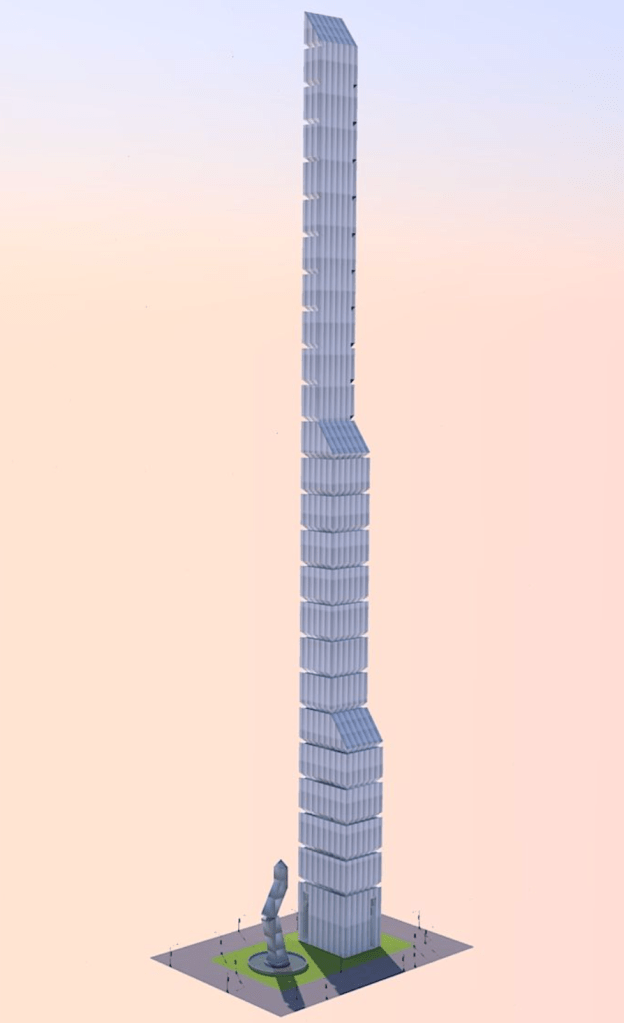
Digital structure made on Sketchup software
by 12th grader Arkady Gurevich
The coronavirus was a disease which started back in 2019 in Wuhan, China. In a time period where in-person interaction was dangerous, remote work was seen as the best solution to all problems. It was one of the main economic impacts of coronavirus as remote work has seen a large increase throughout the past few years. Throughout the past decade, according to Governing, the number of remote workers has increased from 5.7% to 17.9% of the workforce from 2019 to 2021. (Pop-Badiu) Although this number is now slowly decreasing, remote work will definitely continue to stay. Overall, this rise has shaped global cities, urban areas, and commuter behaviors.
One of the main effects on urban economies is that remote work has decreased the demand for office space. The need for less office space has lowered congestion in urban areas and lowered pollution. Specifically, it has led to a decrease in demand for housing in urban areas as labor shifts from urban areas to rural areas. In addition, remote work allows employees to work from almost any location, which increases flexibility and work/life balance. (Quadri) In 2020, as remote work skyrocketed, many workers left big cities to move elsewhere. Places such as Chicago, Dallas, San Francisco, and Washington DC are all places losing out due to remote work. These cities are all facing a large population decline as remote or hybrid work increased. This has already led to the reconstruction of many office buildings to be converted to residential units. According to the TIME Magazine, more than 55,300 housing units are being transformed from office buildings worldwide, a number which has quadrupled when compared back to 2021. (Ahasan) One of the positive effects of more urban workers in rural areas is that it leads to a reduction in the wage gap between urban and rural cities. This leads to a decline in urban wage premium. Overall, office attendance still remains significantly below pre-pandemic levels. In particular, many major urban U.S. cities only receive roughly a third of the former workforce present.
Another major economic effect of remote work is that it has reduced the need for commuting. For commuters, they saw much of the benefit as they saved on average fifty minutes traveling due to remote working in the coronavirus pandemic. In addition, it is able to cut car emissions and pollution. On the other hand, this has had a noticeable impact on transportation systems in urban areas. With fewer workers commuting to offices, there has been a significant decline in public transit ridership. A study from MIT showed that a 1% decrease in onsite workers results in a roughly 1% reduction in vehicle miles driven and a 2.3% reduction in mass transit ridership such as buses or trains. (Zheng et al.) They also found that most people rely on public transport to get to work which led to a large portion of transport ridership being no longer needed. Specifically, New York, one of the hardest-hit cities by remote work, saw its subway ridership drop to less than half of pre-pandemic levels. In addition to the reduction in public transit usage, remote work has changed commuting patterns overall. Remote workers now have more flexibility and can travel during non-peak hours, which reduces congestion during traditional rush hours. This has led to more efficient traffic flow and fewer delays, but it also means a decline in revenue for public transit systems, which are heavily dependent on fare collections. The long-term impact of these changes could reshape urban mobility and influence future transportation planning. To summarize, remote work has unfortunately led to a decrease in public transport and has caused the loss of billions of dollars in revenue.
In addition, remote work has had a major impact on local businesses. Many businesses that formerly relied on daily office workers, such as cafes and restaurants, have seen a decrease in revenue. For example, Starbucks reported a 10% drop in transactions compared to pre-pandemic levels. (Tappe) This is heavily due to fewer office workers stopping by during their commutes. With fewer workers living in urban centers, many local businesses that once thrived on lunchtime crowds or after-work traffic are facing challenges. Some businesses have adapted by expanding their services, including delivery options and online orders, while others have closed down completely. In some cases, businesses that were once popular with office workers are now shifting to cater to residents or tourists instead. The transformation of these local businesses reflects the broader economic changes occurring as more people work remotely. As remote work continues, it may further alter the landscape of local economies, leading to more businesses focused on flexibility and digital models rather than traditional in-person services. Overall, remote work has forced many businesses that once depended on office workers to find alternatives and adapt to new circumstances.
To summarize, remote work, which was heavily motivated by the coronavirus pandemic, has furthered the evolution of many urban cities due the usage of office space, the reduced amount of commuting, and the impact of local businesses. The shift from large urban centers is resulting in fewer workers, a reduction in the number of employees physically attending the offices, and a migration to relatively rural communities. Similarly the usage of public transport has also decreased causing a fall in revenue for transport systems. In addition, many local businesses that depended on occupied offices for turnover, like cafes and restaurants, faced a steep drop in sales causing them to need to adapt to new conventions. While it is true that many of these changes are only short term, it can be expected that remote working culture would have a long-lasting effect on the way people work and will heavily affect the future urban communities.

Biography
I am Jacob Khohayting, a sophomore. I enjoy participating in math and programming in competitions. When not competing, I like to watch soccer.
What motivated you to write this piece?
Extra credit points
How do you resonate with your piece? Why is it personal to you?
I enjoy learning about current events.
 Expressions