
When a punchline walks atop a grave, the audience in front may laugh and frolic, but on the sidelines, a fresh corpse bleeds and decays. It is often that a comedian is criticized for joking about a sensitive topic, but time and again, they claim “it is simply a joke” and that “it helps audiences survive in tough times.” But, in fact, is there any truth to that; can a joke truly help someone recover through hardship? Not in the slightest. Therefore, there are a handful of topics that are unacceptable for comedians to quip about, as some jokes can reveal deeper truths and emotions that may cause harm—especially when targeting sensitive subjects or individuals—and can discourage reflection as well as trivialize serious issues.
First, humor that touches on sensitive subjects can uncover underlying feelings or realities that ultimately cause harm to its targets. A licensed marriage-family therapist and former professional comedy writer cautions that what we dismiss as “just a joke” often conceals exactly the truth that we are unwilling to face. As he explains from his dual vantage point in entertainment and therapy, “Sometimes these jokes are ways for us to express emotions like anger, fear, jealousy, or shame, but in a safer way than talking about them openly. These are the jokes that are so clearly manifestations of the uncomfortable truth that we feel obligated to say, ‘It’s just a joke!’” (Stark). So, although a comedian may claim a joke regarding a sensitive topic is only a witty remark and should not be taken seriously, it is very likely that it holds some truth that the comedian disguises as humor. Such humor often serves as a socially acceptable outlet for expressing uncomfortable emotions or controversial views that might otherwise be criticized or dismissed. This tendency reveals how jokes can act as hidden confessions, concealed in humor to avoid accountability or deeper vulnerability. Moreover, a group of organizational psychologists demonstrate that these “harmless” jabs can inflict measurable damage on their targets. They warn that when negative humor is directed at someone “we may pay the price in lowered self-esteem, self-doubt, anxiety, and loss of energy. It’s hard to stay motivated at work when you begin to question your credibility …. And fear weakens the immune system, which increases illnesses and absenteeism” (McGee-Cooper et al.). Thus, there is a potential psychological and physical harm that jokes can inflict on their targets, especially in professional or personal contexts. Beyond simple discomfort, these impacts can erode a person’s mental health, productivity, and sense of belonging—especially when humor becomes a normalized form of exclusion or subtle aggression. The long-term consequences are not just emotional but can also manifest physically, diminishing both morale and well-being. Palpably, insensitive jokes contain some truth and can have detrimental effects on the intended recipient.
Conversely, it is often argued that comedy helps audiences reflect on and think through tough issues. A joke about a fragile matter may serve as a coping mechanism, relieve stress, and offer breathing room. Critics of that view, however, note that humor more often minimizes the significance of serious subjects and invites laughter rather than contemplation. Bustillos-Reynolds, a humor-studies scholar and stand-up comedienne, assessed an SNL “Weekend Update” segment in which Leslie Jones joked about her “usefulness” as an enslaved woman and found it failed even its own stated aim of consciousness-raising. As she argues, “If Jones’ purpose for delivering this joke was to invoke consciousness-raising, she fell short of the job. Humorous consciousness-raising is most successful when we … take a seemly noble act and promote it as ignoble. In other words, resistance humor works well when we challenge normative scripts that perpetuate oppression of marginalized individuals; it doesn’t work if we reinforce those scripts in our humor.” Hence, using comedy for social critique only functions as a tool for reflection if it successfully disrupts oppressive narratives. When it does not, it not only loses its critical edge but can also cause harm by normalizing or trivializing deeply traumatic histories. Furthermore, cultural critic Garo underscores how jokes can cement systemic injustice. Reflecting on the legacy of minstrel shows and the naming of Jim Crow laws, she reminds us that “it is difficult to see how comedy has no real-world impact when the period of American apartheid was named after a popular comedy character. Though it might have been a show intended to entertain, Blackness was its punchline, and generations of anti-Black stereotypes were its legacy.” Humor is connected to lasting societal harm, as what may be presented as “just entertainment” can, in fact, contribute to the normalization and prolongation of systemic oppression. Comedy, when used irresponsibly, can desensitize audiences to injustice, making serious issues seem less urgent or even acceptable. Evidently, comedy rarely encourages reflection but rather belittles the significance of a sensitive topic.
To conclude, comedians should steer clear of making insensitive jokes, particularly those aimed at delicate topics or groups, because they can unintentionally expose painful hidden truths, leading to harm. They may also undermine thoughtful discussion and make light of important matters. Understanding the impact of humor is important because it shapes how we engage with serious topics, influences social attitudes, and either promotes empathy or perpetuates harm. By recognizing the power jokes hold, we become more mindful of the ways language can affect others and contribute to meaningful dialogue rather than silencing it.

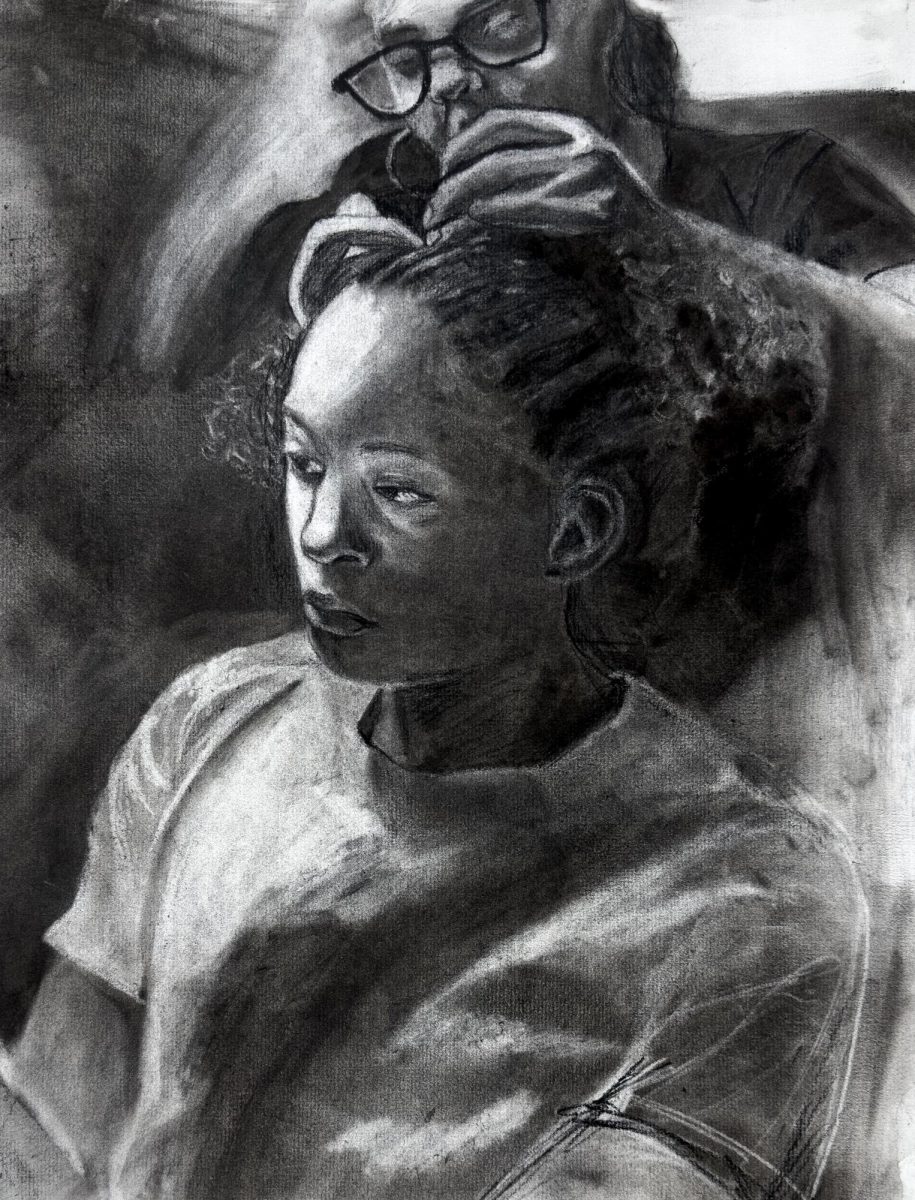
Acrylic, Charcoal, Image Transfer by Reese Pasalodos
Works Cited
Bustillos-Reynolds, Sheila. “SNL’s Leslie Jones Offers Anachronistic Jokes on Slavery.” The Feminist Wire, 14 May 2014, thefeministwire.com/2014/05/snls-leslie-jones-offers-anachronistic-jokes-slavery/.
Garo, Isabella. “It’s Never ‘Just a Joke’: The Political and Cultural Power of Comedy.” Brown Political Review, 26 Mar. 2023, brownpoliticalreview.org/the-political-and-cultural-power-of-comedy/.
McGee-Cooper, Ann, et al. “The High Cost of Negative Humor.” The Systems Thinker, 24 Jan. 2016, thesystemsthinker.com/the-high-cost-of-negative-humor/.
Stark, Phil. “It’s (Not) Just a Joke.” Psychology Today, Sussex Publishers, 9 Oct. 2025, www.psychologytoday.com/us/blog/dude-wheres-my-car-tharsis/202205/its-not-just-a-joke.